
Friday, March 11, 2016
Follow-up on Hackley Manuscript
Just a quick note on the Hackley manuscript mentioned in the post on "The (Supposed) Ancestors of Nicholas Ackley". I heard back from Damien Rostar at the Hackley Library in Muskegon, Michigan, and the original manuscript referred to in Louis P. Haight's book, The Life of Charles Henry Hackley, was found in the library. Unfortunately there was no additional information in the manuscript; Damien reports that "The item itself is exactly the same as the genealogical section of Haight's book, right down to the cryptic citations (I checked line-by-line to make sure the information was the same in each)." Thanks to Damien for his diligence in following up! So for now the information in Haight's book is all we have to go on.

Wednesday, March 9, 2016
James Ackley (1678-1746) and His Family
From time to time I plan on covering each of Nicholas' children and their families in a little more depth. Since James was my 6th great grandfather and I am most familiar with him, he gets to go first.
James Ackley was the ninth of ten children born to Nicholas and Hannah Ackley. He was born about 1677 or 1678, presumably in Haddam, Connecticut, and died on 19 Sep 1746 in East Haddam, Connecticut [10]. His birth year is estimated based on his age at death given on his tombstone - the inscription said he was in his 69th year of age.
James married his wife Elizabeth around 1706 according to marriage records on Ancestry [1]. According to Elizabeth's headstone, she died on 19 Sep 1755 (9 years to the day after her husband) in her 66th year, which would make her birth year about 1689 or 1690 [10]. This marriage record gives her maiden name as Comedy, which is the most frequently occurring name I have seen for her online. However, none of the published genealogies such as Dawes-Gates give a last name for her, and there just aren't any other records for an Elizabeth Comedy online that I can find. Find-A-Grave has her last name as Cowdrey, with a birth date of 6 Oct 1689 in Reading, Massachusetts. There is an Elizabeth Cowdery with that birth date in a published genealogy for the Cowdrey family, but it is doubtful that this Elizabeth Cowdery could be James' wife because she married Timothy Goodwin in 1708 [2].
Apparently James could read and write, or at the very least sign his name; his signature appears on his father's will as well as his own will, while several of his siblings just made their mark - an "X" next to their names. Here is his signature from his will:

Although there is no definitive documentation concerning James' occupation, it is logical to conclude that he was a farmer, as were many people in colonial times. Many of the items listed in the estate inventory in his probate documentation are farm-related -- cows, horses, a yoke of oxen, a yoke of steers, farm implements, as well as a barn [9].
James and Elizabeth were buried in Old Cove Burying Ground in East Haddam, Connecticut. Here are pictures of their headstones:

James and Elizabeth had seven children, all of whom were mentioned in James' will [9]. Their children were:
1. James Ackley was born 17 Jul 1707 in East Haddam, Connecticut [11], and died 31 Dec 1777 in East Hampton, Connecticut [14]. James was married twice. First he married Naomi Gaines about 1732 in East Haddam, Connecticut. His second wife was Sarah Gates, whom he married on 28 Oct 1742 in Middletown, Connecticut [22].
James and Naomi had one son:
a. James Ackley was born 18 Jan 1739 in East Haddam, Connecticut [19].
James and Sarah had three children:
a. Sarah Ackley was born on 15 Sep 1743 in Middletown, Connecticut [19].
b. Naomi Ackley was born 14 Aug 1745 in Middletown, Connecticut [19].
c. Samuel Ackley was born 2 Sep 1747 in Middletown, Connecticut [19].
2. Nicholas Ackley was born 16 Dec 1708 in East Haddam, Connecticut [11], and died about 1763 [13]. Nicholas married twice. His first wife was Jerusha ?. His second wife was Sarah Wilson. Nicholas and Jerusha had three children:
a. Jeremiah Ackley was born on 26 Sep 1742 in Colchester, Connecticut [13], [24], and died in Feb 1817 in Lancaster, New York [13]. He married Sarah Woodson.
b. Jerusha Ackley was born on 30 Dec 1744 in Colchester, Connecticut [24].
c. Sarah Ackley was born on 5 Nov 1749 in Colchester, Connecticut [24].
Nicholas and Sarah had two children:
a. Lewis Ackley was born 5 Jan 1758 in Colchester, Connecticut [17].
b. Nicholas Ackley was born 2 Jun 1762 in Colchester, Connecticut [17].
3. Nathaniel Ackley was born 7 Nov 1712 in East Haddam, Connecticut [11], [21], and died 18 Sep 1794 in Millington, Connecticut [10],[13]. Nathaniel was married twice. His first wife, and the mother of all of his children, was Mary Williams. They were married 16 Apr 1734 in East Haddam, Connecticut [15]. Mary's birth date is unknown. She died before 20 Dec 1792 in Milllington, Connecticut (this date is established by Nathaniel's marriage to Hannah Smith). Nathaniel married the widow Hannah Smith at the age of 80 on 20 Dec 1792 in East Haddam, Connecticut [16]. Nathaniel and Mary had the following children:
a. Mary Ackley was born 27 May 1735 in East Haddam, Connecticut [13], [21], and died 14 Jul 1764 in East Haddam, Connecticut [13].
b. Ruth Ackley was born 3 Dec 1737 in East Haddam, Connecticut [13], [21].
c. Nathaniel Ackley was born 19 Apr 1740 in East Haddam, Connecticut [17], [21], and died 2 Dec 1759 in East Haddam, Connecticut [18], [21].
d. Elizabeth Ackley was born 16 Mar 1745 in East Haddam, Connecticut [13],[19], [21], and died in 1832 in New Haven, Connecticut [13].
e. Henry Ackley was born 1 Sep 1747 in East Haddam, Connecticut [17], [21].
f. Lidia Ackley was born 28 Aug 1749 in East Haddam, Connecticut [17], [21], and died 12 Feb 1826 in East Haddam, Connecticut [14].
g. Ephraim Ackley was born 25 Feb 1751/52 in East Haddam, Connecticut [17], [21], and died 12 Oct 1822 [20].
h. Candis Ackley was born 20 Jul 1756 in East Haddam, Connecticut [13], [21].
i. Warren Ackley was born 17 Oct 1758 in East Haddam, Connecticut [13], [21].
4. Gideon Ackley was born 14 Apr 1716 in East Haddam, Connecticut [12], and died 1 Dec 1803 in East Haddam, Connecticut [14]. Gideon was married twice. He first married Hannah Andrews on 24 Mar 1737 in East Haddam, Connecticut [15]. His second marriage was to Deborah Rowley on 27 Oct 1763 in East Haddam, Connecticut [16].
Hannah and Gideon had three daughters:
a. Thankful Ackley was born 1 Jun 1737 in East Haddam, Connecticut [17].
b. Abigail Ackley was born 29 Nov 1738 in East Haddam, Connecticut [17].
c. Hannah Ackley was born 18 Mar 1742 in East Haddam, Connecticut [17].
Deborah and Gideon had two daughters:
a. Deborah Ackley was born 13 Jun 1766 in East Haddam, Connecticut [17].
b. Mary Ackley was born 14 Sep 1767 in East Haddam, Connecticut [17].
5. Desire Ackley was born 24 Feb 1717 in East Haddam, Connecticut [12], and died in 1788 [13]. Desire marred Acquillah Calkins on 27 May 1741 in Hebron, Connecticut [16]. Desire and Acquillah had nine children:
a. Abigail Calkins was born 7 Jun 1742 in Hebron, Connecticut [17].
b. Nathaniel Calkins was born 9 Feb 1743 in Hebron, Connecticut [17].
c. James Calkins was born about 1745 [14].
d. Abigail Calkins was born 18 Sep 1748 in Colchester, Connecticut [17].
e. Desire Calkins was born 11 Nov 1750 in Colchester, Connecticut.
f. Hannah Calkins was born 19 Aug 1754 in Colchester, Connecticut [17].
g. Hannah Calkins was born in Nov 1755.
h. Molly Callkins was born 19 Jun 1759 in East Haddam, Connecticut [17].
i. Lucy Calkins was born 1 May 1762 in East Haddam, Connecticut [17].
6. Elizabeth Ackley was born 16 Jan 1722 in East Haddam, Connecticut [12], and died Mar 1795 [13]. Elizabeth married Richard Andrews on 10 Jul 1740 in East Haddam, Connecticut [16]. Elizabeth and Richard had eight children:
a. Esther Andrews was born on 15 Jun 1738 in East Haddam, Connecticut [17].
b. Eleanor Andrews was born on 10 May 1741 in East Haddam, Connecticut [17].
c. Asahel Andrews was born on 20 Feb 1742 in East Haddam, Connecticut [17].
d. Mary Andrews was born on 7 Aug 1745 in East Haddam, Connecticut [17].
e. John Andrews was born on 17 Jul 1746 in East Haddam, Connecticut [17] and died 24 Oct 1809 in East Haddam, Connecticut [18].
f. Elizabeth Andrews was born on 24 Jun 1750 in East Haddam, Connecticut [17].
g. Joseph Andrews was born on 3 Nov 1752 in East Haddam, Connecticut [17].
h. Abigail Andrews was born on 25 Apr 1755 in East Haddam, Connecticut [17].
7. Benajah Ackley was born 10 Jul 1729 in East Haddam, Connecticut [12]. Benajah married Lurany Bill on 21 May 1747 in Lebanon-Goshen, Connecticut [16]. Benajah and Lurany had two children:
a. Adonijah Ackley was born 1 Feb 1750 [13] and died 4 Aug 1751 [13].
b. Benajah Ackley was born about 1755. He died 16 May 1830 in Whiting, Maine [23].
Although the witchcraft crisis in Salem, Massachusetts in the late 1600s is more well-known, Connecticut had its share of accusations and trials. James and Elizabeth were caught up in the witchcraft hysteria in 1724. Elizabeth claimed she had been "hagridden [tormented] and pinched" by the shape of Sarah Spencer, and James threatened to retaliate. Sarah sued James and Elizabeth for the sum of 500 pounds for defamation (a fortune at the time); the court awarded her 5 pounds. James and Elizabeth appealed and the award was reduced to one shilling, and James and Elizabeth were found not insane. This case was the last witchcraft trial held in Connecticut. [5] [6] [7] [8]
An interesting aspect of this case is that Sarah Spencer, the widow of William Spencer, was James Ackley's sister.

The line that is boxed in says: "one negro woman 50-0-0 one negro girl 50-0-0 100-0-0". The monetary units used here are pounds, shillings, and pence, so each of these woman was valued at 50 pounds for a total of 100 pounds. The total value of the estate listed in the probate documents was 288-2-8, so these two women made up over one-third of the value of the estate. It is not clear from the will if these women were given to his wife or one of the children upon his death.
When I read that, I had to do some research to find out how prevalent slavery was in the north -- I guess naively I didn't realize there had been slaves in the north at all. I found a website about slavery in the north developed by historian Douglas Harper. According to the website, there were slaves in all of the original 13 colonies, and Connecticut had the most in New England:
Here is the link to the website on slavery in the north; there are pages on states other than Connecticut:
http://slavenorth.com
"Obstacles are those frightful things you see when you take your eyes off the goal."
--Henry Ford
James Ackley was the ninth of ten children born to Nicholas and Hannah Ackley. He was born about 1677 or 1678, presumably in Haddam, Connecticut, and died on 19 Sep 1746 in East Haddam, Connecticut [10]. His birth year is estimated based on his age at death given on his tombstone - the inscription said he was in his 69th year of age.
James married his wife Elizabeth around 1706 according to marriage records on Ancestry [1]. According to Elizabeth's headstone, she died on 19 Sep 1755 (9 years to the day after her husband) in her 66th year, which would make her birth year about 1689 or 1690 [10]. This marriage record gives her maiden name as Comedy, which is the most frequently occurring name I have seen for her online. However, none of the published genealogies such as Dawes-Gates give a last name for her, and there just aren't any other records for an Elizabeth Comedy online that I can find. Find-A-Grave has her last name as Cowdrey, with a birth date of 6 Oct 1689 in Reading, Massachusetts. There is an Elizabeth Cowdery with that birth date in a published genealogy for the Cowdrey family, but it is doubtful that this Elizabeth Cowdery could be James' wife because she married Timothy Goodwin in 1708 [2].
Apparently James could read and write, or at the very least sign his name; his signature appears on his father's will as well as his own will, while several of his siblings just made their mark - an "X" next to their names. Here is his signature from his will:
Although there is no definitive documentation concerning James' occupation, it is logical to conclude that he was a farmer, as were many people in colonial times. Many of the items listed in the estate inventory in his probate documentation are farm-related -- cows, horses, a yoke of oxen, a yoke of steers, farm implements, as well as a barn [9].
James and Elizabeth were buried in Old Cove Burying Ground in East Haddam, Connecticut. Here are pictures of their headstones:

Children
James and Elizabeth had seven children, all of whom were mentioned in James' will [9]. Their children were:
1. James Ackley was born 17 Jul 1707 in East Haddam, Connecticut [11], and died 31 Dec 1777 in East Hampton, Connecticut [14]. James was married twice. First he married Naomi Gaines about 1732 in East Haddam, Connecticut. His second wife was Sarah Gates, whom he married on 28 Oct 1742 in Middletown, Connecticut [22].
James and Naomi had one son:
a. James Ackley was born 18 Jan 1739 in East Haddam, Connecticut [19].
James and Sarah had three children:
a. Sarah Ackley was born on 15 Sep 1743 in Middletown, Connecticut [19].
b. Naomi Ackley was born 14 Aug 1745 in Middletown, Connecticut [19].
c. Samuel Ackley was born 2 Sep 1747 in Middletown, Connecticut [19].
2. Nicholas Ackley was born 16 Dec 1708 in East Haddam, Connecticut [11], and died about 1763 [13]. Nicholas married twice. His first wife was Jerusha ?. His second wife was Sarah Wilson. Nicholas and Jerusha had three children:
a. Jeremiah Ackley was born on 26 Sep 1742 in Colchester, Connecticut [13], [24], and died in Feb 1817 in Lancaster, New York [13]. He married Sarah Woodson.
b. Jerusha Ackley was born on 30 Dec 1744 in Colchester, Connecticut [24].
c. Sarah Ackley was born on 5 Nov 1749 in Colchester, Connecticut [24].
Nicholas and Sarah had two children:
a. Lewis Ackley was born 5 Jan 1758 in Colchester, Connecticut [17].
b. Nicholas Ackley was born 2 Jun 1762 in Colchester, Connecticut [17].
3. Nathaniel Ackley was born 7 Nov 1712 in East Haddam, Connecticut [11], [21], and died 18 Sep 1794 in Millington, Connecticut [10],[13]. Nathaniel was married twice. His first wife, and the mother of all of his children, was Mary Williams. They were married 16 Apr 1734 in East Haddam, Connecticut [15]. Mary's birth date is unknown. She died before 20 Dec 1792 in Milllington, Connecticut (this date is established by Nathaniel's marriage to Hannah Smith). Nathaniel married the widow Hannah Smith at the age of 80 on 20 Dec 1792 in East Haddam, Connecticut [16]. Nathaniel and Mary had the following children:
a. Mary Ackley was born 27 May 1735 in East Haddam, Connecticut [13], [21], and died 14 Jul 1764 in East Haddam, Connecticut [13].
b. Ruth Ackley was born 3 Dec 1737 in East Haddam, Connecticut [13], [21].
c. Nathaniel Ackley was born 19 Apr 1740 in East Haddam, Connecticut [17], [21], and died 2 Dec 1759 in East Haddam, Connecticut [18], [21].
d. Elizabeth Ackley was born 16 Mar 1745 in East Haddam, Connecticut [13],[19], [21], and died in 1832 in New Haven, Connecticut [13].
e. Henry Ackley was born 1 Sep 1747 in East Haddam, Connecticut [17], [21].
f. Lidia Ackley was born 28 Aug 1749 in East Haddam, Connecticut [17], [21], and died 12 Feb 1826 in East Haddam, Connecticut [14].
g. Ephraim Ackley was born 25 Feb 1751/52 in East Haddam, Connecticut [17], [21], and died 12 Oct 1822 [20].
h. Candis Ackley was born 20 Jul 1756 in East Haddam, Connecticut [13], [21].
i. Warren Ackley was born 17 Oct 1758 in East Haddam, Connecticut [13], [21].
4. Gideon Ackley was born 14 Apr 1716 in East Haddam, Connecticut [12], and died 1 Dec 1803 in East Haddam, Connecticut [14]. Gideon was married twice. He first married Hannah Andrews on 24 Mar 1737 in East Haddam, Connecticut [15]. His second marriage was to Deborah Rowley on 27 Oct 1763 in East Haddam, Connecticut [16].
Hannah and Gideon had three daughters:
a. Thankful Ackley was born 1 Jun 1737 in East Haddam, Connecticut [17].
b. Abigail Ackley was born 29 Nov 1738 in East Haddam, Connecticut [17].
c. Hannah Ackley was born 18 Mar 1742 in East Haddam, Connecticut [17].
Deborah and Gideon had two daughters:
a. Deborah Ackley was born 13 Jun 1766 in East Haddam, Connecticut [17].
b. Mary Ackley was born 14 Sep 1767 in East Haddam, Connecticut [17].
5. Desire Ackley was born 24 Feb 1717 in East Haddam, Connecticut [12], and died in 1788 [13]. Desire marred Acquillah Calkins on 27 May 1741 in Hebron, Connecticut [16]. Desire and Acquillah had nine children:
a. Abigail Calkins was born 7 Jun 1742 in Hebron, Connecticut [17].
b. Nathaniel Calkins was born 9 Feb 1743 in Hebron, Connecticut [17].
c. James Calkins was born about 1745 [14].
d. Abigail Calkins was born 18 Sep 1748 in Colchester, Connecticut [17].
e. Desire Calkins was born 11 Nov 1750 in Colchester, Connecticut.
f. Hannah Calkins was born 19 Aug 1754 in Colchester, Connecticut [17].
g. Hannah Calkins was born in Nov 1755.
h. Molly Callkins was born 19 Jun 1759 in East Haddam, Connecticut [17].
i. Lucy Calkins was born 1 May 1762 in East Haddam, Connecticut [17].
6. Elizabeth Ackley was born 16 Jan 1722 in East Haddam, Connecticut [12], and died Mar 1795 [13]. Elizabeth married Richard Andrews on 10 Jul 1740 in East Haddam, Connecticut [16]. Elizabeth and Richard had eight children:
a. Esther Andrews was born on 15 Jun 1738 in East Haddam, Connecticut [17].
b. Eleanor Andrews was born on 10 May 1741 in East Haddam, Connecticut [17].
c. Asahel Andrews was born on 20 Feb 1742 in East Haddam, Connecticut [17].
d. Mary Andrews was born on 7 Aug 1745 in East Haddam, Connecticut [17].
e. John Andrews was born on 17 Jul 1746 in East Haddam, Connecticut [17] and died 24 Oct 1809 in East Haddam, Connecticut [18].
f. Elizabeth Andrews was born on 24 Jun 1750 in East Haddam, Connecticut [17].
g. Joseph Andrews was born on 3 Nov 1752 in East Haddam, Connecticut [17].
h. Abigail Andrews was born on 25 Apr 1755 in East Haddam, Connecticut [17].
7. Benajah Ackley was born 10 Jul 1729 in East Haddam, Connecticut [12]. Benajah married Lurany Bill on 21 May 1747 in Lebanon-Goshen, Connecticut [16]. Benajah and Lurany had two children:
a. Adonijah Ackley was born 1 Feb 1750 [13] and died 4 Aug 1751 [13].
b. Benajah Ackley was born about 1755. He died 16 May 1830 in Whiting, Maine [23].
Witchcraft Accusers
Although the witchcraft crisis in Salem, Massachusetts in the late 1600s is more well-known, Connecticut had its share of accusations and trials. James and Elizabeth were caught up in the witchcraft hysteria in 1724. Elizabeth claimed she had been "hagridden [tormented] and pinched" by the shape of Sarah Spencer, and James threatened to retaliate. Sarah sued James and Elizabeth for the sum of 500 pounds for defamation (a fortune at the time); the court awarded her 5 pounds. James and Elizabeth appealed and the award was reduced to one shilling, and James and Elizabeth were found not insane. This case was the last witchcraft trial held in Connecticut. [5] [6] [7] [8]
An interesting aspect of this case is that Sarah Spencer, the widow of William Spencer, was James Ackley's sister.
Slave Owner
Yes, you read that heading correctly, James Ackley was a slave owner. When I was reading through his will and probate documents, I found the following among the estate inventory papers:

The line that is boxed in says: "one negro woman 50-0-0 one negro girl 50-0-0 100-0-0". The monetary units used here are pounds, shillings, and pence, so each of these woman was valued at 50 pounds for a total of 100 pounds. The total value of the estate listed in the probate documents was 288-2-8, so these two women made up over one-third of the value of the estate. It is not clear from the will if these women were given to his wife or one of the children upon his death.
When I read that, I had to do some research to find out how prevalent slavery was in the north -- I guess naively I didn't realize there had been slaves in the north at all. I found a website about slavery in the north developed by historian Douglas Harper. According to the website, there were slaves in all of the original 13 colonies, and Connecticut had the most in New England:
"... on the eve of the Revolution, Connecticut had the largest number of slaves (6,464) in New England. ... All the principal families of Norwich, Hartford, and New Haven were said to have one or two slaves. By 1774, half of all the ministers, lawyers, and public officials owned slaves, and a third of all the doctors. But Connecticut's large slave population apparently was based in the middle class. More people had the opportunity to own slaves than in Massachusetts or Rhode Island, so more did so." [3]The ConnecticutHistory.org website had this to say about slavery in Connecticut:
"Slavery in Connecticut dates as far back as the mid-1600s. Connecticut’s growing agricultural industry fostered slavery’s expansion, and by the time of the American Revolution, Connecticut had the largest number of slaves in New England. After the war, new ideas about freedom and the rights of men brought about the movement to end slavery in the US. In contrast to neighboring states, however, Connecticut emancipated its slaves very slowly and cautiously, claiming it wanted to ensure the process respected property rights and did not disrupt civic order. Connecticut passed the Gradual Abolition Act of 1784, but this act did not emancipate any enslaved persons, only those who would be born into slavery and only after they reached the age of 25. This gradual process meant that slavery in Connecticut did not officially end until 1848—long after many other Northern states had abolished the practice." [4]This goes to show you that when you are researching your family history, you have to be prepared to discover the bad things, as well as the good things, about your ancestors. I have to admit that this discovery was quite a shock to me personally -- one of my direct line Ackley ancestors participated in one of the most shameful practices in American history -- owning another human being. But, you don't get to pick your ancestors; so you can only try to live your own life as honorably as possible and hope that your actions stand the test of time.
Discussion Questions
- Does anyone have any good documentation on the last name for James' wife Elizabeth?
- Is anyone a descendant of James?
- What is your reaction to the news that James was a slave owner?
Link of the Day
Here is the link to the website on slavery in the north; there are pages on states other than Connecticut:
http://slavenorth.com
Quote of the Day
"Obstacles are those frightful things you see when you take your eyes off the goal."
--Henry Ford
Sources
- Yates Publishing. U.S. and International Marriage Records, 1560-1900 [database on-line]. Provo, UT, USA: Ancestry.com Operations Inc, 2004.
- Mehling, Mary Bryant Alverson, Cowdrey-Cowdery-Cowdray genealogy : William Cowdrey of Lynn, Massachusetts, 1630, and his descendants (New York: F. Allaben Genealogical Co.,1911)
- http://slavenorth.com/connecticut.htm
- http://connecticuthistory.org/topics-page/slavery-and-abolition/
- Taylor, John M., The Witchcraft Delusion in Colonial Connecticut, 1647-1697 (New York: The Grafton Press, 1908), p. 155.
- Tomlinson, R.G., Witchraft Trials of Connecticut (Hartford: The Bond Press, 1978), p. 65-66.
- Karlsen, Carol F., The Devil in the Shape of a Woman: Witchcraft in Colonial New England (New York: W.W. Norton & Company, 1998), p. 45.
- American Historical Magazine, Vol. I, January, 1906-November, 1906 (New York: The Publishing Society of New York, 1906), p. 237.
- Ancestry.com. Connecticut, Wills and Probate Records, 1609-1999 [database on-line]. Provo, Utah: Ancestry.com Operations, Inc., 2015.
- Ferris, Mary Walton, Dawes-Gates Ancestral Lines: A Memorial Volume Containing the American Ancestry of Mary Beman (Gates) Dawes Vol. II (Wisconsin: Cuneo Press, 1931), p. 33-54.
- “First Book East Haddam Land Records”, The New England Historical and Genealogical Register, Volume XI, Samuel G. Drake, Editor. (Boston: C. Benjamin Richardson, 1857), p. 273-278.
- “First Book East Haddam Land Records”, The New England Historical and Genealogical Register, Volume XII, Samuel G. Drake, Editor. (Boston: C. Benjamin Richardson, 1858), p. 42-47.
- Ancestry.com. U.S., Find A Grave Index, 1600s-Current [database on-line]. Provo, UT, USA: Ancestry.com Operations, Inc., 2012.
- Ancestry.com. Connecticut, Deaths and Burials Index, 1650-1934 [database on-line]. Provo, Utah: Ancestry.com Operations, Inc., 2011.
- Ancestry.com. Connecticut, Town Marriage Records, pre-1870 (Barbour Collection) [database on-line]. Provo, UT, USA: Ancestry.com Operations Inc, 2006.
- Ancestry.com. Early Connecticut Marriages [database on-line]. Provo, UT, USA: Ancestry.com Operations, Inc., 2012.
- Ancestry.com. Connecticut Town Birth Records, pre-1870 (Barbour Collection) [database on-line]. Provo, UT, USA: Ancestry.com Operations Inc, 2006.
- Ancestry.com. Connecticut Town Death Records, pre-1870 (Barbour Collection) [database on-line]. Provo, UT, USA: Ancestry.com Operations Inc, 2006.
- "Connecticut Births and Christenings, 1649-1906," database, FamilySearch(https://familysearch.org/ark:/61903/1:1:F77D-LQ2 : accessed 7 February 2016)
- Winton, Caroll Ackley, Ackley & Winton Genealogy and Allied Lines (1949).
- East Haddam (Connecticut). Registrar of Vital Statistics, Records of births, marriages, and deaths, 1687-1915 (Salt Lake City, Utah : Filmed by the Genealogical Society of Utah, 1984, 1987)
- "Connecticut Marriages, 1630-1997," database, FamilySearch(https://familysearch.org/ark:/61903/1:1:F7LW-FPG : accessed 7 February 2016)
- Death Notice for Benajah Ackley, Eastport Sentinel, Volume XII, Issue 43, 2 Jun 1830, p. 3.
- Hinman, Royal Ralph, Catalogue of the Names of the First Puritan Settlers of the Colony of Connecticut (Hartford, Connecticut: E. Gleanson, 1846), p. 110.
Next Post Topic
Where in the World Do Ackleys Live?
Wednesday, March 2, 2016
Some "Other" Ackley Lines
The posts up to this point have concentrated on Nicholas Ackley and his family. While many of us can trace our ancestry back to Nicholas, there are other Ackley lines that either do not have a connection to Nicholas at all or just have not been able to establish a connection yet. In many cases people researching these lines have run into the proverbial "brick wall" -- the paper trail has ended before they could trace the line back to either Nicholas Ackley or some other Ackley immigrant who came to America from somewhere else. Today's post will discuss two such lines that were brought to my attention by readers. To keep things simple, we'll only cover the earliest known ancestor from each line and their children. The idea is to introduce them and hope that other readers have either researched the lines or might have some clues.
Thanks to Donovan Ackley for bringing this line to my attention.
The progenitor of this line, Lewis Ackley, was born in Otsego County, New York on 4 July 1809 [1], and died in Noble County, Ohio on 22 Apr 1892 [1]. Lewis married Maria Grace around 1828. Maria was born 28 Oct 1807 in Pennsylvania [1], and died 19 Sep 1887 in Noble County, Ohio [1]. Lewis and Maria were both buried in Olive Cemetery in Caldwell, Ohio [1]. Since he was only 11 years old for the 1820 census, which only listed the heads of household, he would not be found by name in the 1820 or 1810 censuses. Lewis is listed as the head of his household and living in Ohio in every U.S. census from 1830 to 1880. Note about counties: Morgan County was formed in 1817 from parts of Guernsey, Muskingum, and Washington Counties; Lewis is listed as living in Morgan County in the 1830, 1840, and 1850 U.S. Federal Censuses. Noble County was formed in 1851 from parts of Guernsey, Morgan, Monroe, and Washingtion Counties; Lewis is listed as living in Noble County in the 1860, 1870, and 1880 U.S. Federal Censuses. His occupation is given as carpenter in the 1850 census, and farmer in every census after that. One interesting fact from the 1870 census -- there is a column for parentage of each person listed, and the column labelled "Father of foreign birth" is checked for Lewis. The column for his mother is not checked. However, in the 1880 census the birthplace for both of Lewis' parents is listed as New York. The censuses before 1870 did not collect information on parents' birthplaces.
Lewis purchased 40 acres of land in Morgan County, Ohio in 1837 [2].

In the 1860 U.S. Federal Census Non-Population Schedule, Lewis is shown owning a farm in Noble County, Ohio with 126 acres worth $3,000. His farm implements and machinery were valued at $100. He also owned various livestock, including 4 horses, 6 milk cows, 4 working oxen, 4 other cattle, 19 sheep, and 2 swine, total value of $560. His farm also produced wheat, corn, oats, wool, peas, beans, butter, and cheese [3].


In the 1880 U.S. Federal Census Non-Population Schedule, Lewis is again shown as a farm owner in Noble County, Ohio. By this time the farm is 70 acres, and his son Columbus is listed on the line just below Lewis as a farm owner with a 30 acre farm [3].
Lewis and Maria had nine children:
1. Jane Ackley was born 5 Jan 1830 in Ohio [1], and died 2 Jan 1916 in Noble County, Ohio [1]. Jane married Greenberry Joseph Davis on 12 Apr 1848 in Morgan County, Ohio [4]. Jane and Greenberry had 12 children.
2. Samuel Ackley was born 23 Sep 1831 in Licking County, Ohio [1] and died 23 Sep 1897 in Noble County, Ohio [1]. Samuel was married twice. His first wife was Melinda Ogle, whom he married in Noble County, Ohio on 12 Dec 1861 [4], and his second wife was Sarah McGarry. Samuel and Sarah were married in Noble County on 25 Mar 1885 [4]. Samuel and Melinda had 6 children; Samuel and Sarah had 5 children.
3. Eli (Elijah) Ackley was born in 1834 in Ohio [1] and died 24 Sep 1876 in Noble County, Ohio [7]. He married Susannah Hanawalt. Eli is listed as blind in the 1850, 1860, and 1870 U.S. Federal Censuses. Elijah and Susannah had 5 children.
4. Mary Ackley was born 30 Sep 1837 in Noble County, Ohio [5] and died 22 Feb 1932 in Columbus, Ohio [5]. She married Thomas Bond in Noble County, Ohio on 12 May 1866 [4]. Mary and Thomas had no known children.
5. Maranda Ackley was born 3 Mar 1804 in Noble County, Ohio [1], and died 8 Nov 1920 in Richland County, Wisconsin [1]. She married Samuel Noble on 13 Mar 1861 in Noble County, Ohio [4]. Maranda and Samuel had 3 children.
6. William Ackley was born about 1842 in Ohio [6].
7. Washington Ackley was born about 1844 in Ohio [6].
8. Emeline Ackley was born about 1846 in Ohio [1] and died about 1883 [1] in Ohio. She married James Hurst on 1 Feb 1865 in Noble County, Ohio [4]. Emeline and James had 7 children.
9. Columbus Ackley was born 12 Mar 1849 in Ohio [1], and died 17 Aug 1927 in Noble County, Ohio [5]. He married Margaret Hurst on 17 Feb 1871 in Noble County, Ohio [4]. Columbus and Margaret had 9 children.
The earliest known ancestor for this line is Daniel. He is believed to have been born around 1760 in Little Egg Harbor, New Jersey [8]. He died about 1816 in Wilkes-Barre, Pennsylvania [8]. Daniel served in the Revolutionary War in Capt. John Phillips' Company in the Third New Jersey Regiment [8],[10]. He married Sarah Jane (Price) Parker, the widow of John Parker, in 1790 [8]. Daniel is found in tax records in Gloucester County, New Jersey in the years 1792-1797 as well as 1802 [9]. In 1810 he is found in the census for Pittstown, Luzerne County, Pennsylvania [12]. Daniel and Sarah had seven children:
1. Samuel Ackley was born on 14 Jun 1792, probably in Little Egg Harbor, New Jersey [11], and died 14 Aug 1825 in Plymouth, Pennsylvania [11]. He married Keturah Lamoreux on 18 Jun 1815 in Plymouth, Luzerne County, Pennsylvania [11]. Samuel and Keturah had 2 children.
2. Mary Ackley was born 5 Sep 1793 in Gloucester County, New Jersey [11], and died 22 Jul 1825 in Pittstown, Luzerne County, Pennsylvania [11]. Mary married Jacob Fell on 8 Oct 1814 in Luzerne County, Pennsylvania [11]. Mary and Jacob had 5 children.
3. Elizabeth Ackley was born on 16 Jun 1796, probably in Little Egg Harbor, New Jersey [1], [11], and died 7 Dec 1834 in Greene County, Pennsylvania [1], [11]. She never married [11].
4. Jehu Ackley was born on 11 Nov 1798, probably in Little Egg Harbor, New Jersey [11], and died on 15 May 1848 in Athens County, Ohio [11]. He married Elizabeth Ator/Eator/Eaton in 1823 [11]. She died in Greene County, Pennsylvania on 18 Mar 1836 [11]. Jehu next married Susannah Day on 21 Aug 1836 in Pratt's Fork, Athens County, Ohio [4], [11]. Jehu and Elizabeth had 6 children as did Jehu and Susannah.
5. Naomi Ackley was born 31 Dec 1801 in New Jersey [11], and died 2 Jan 1885 in Greene County, Pennsylvania [11]. She never married [11].
6. Joshua Ackley was born 2 Jul 1804 in Little Egg Harbor, New Jersey [11], and died on 30 Sep 1881 in Greene County, Pennsylvania [11], [13]. He was married three times. He married his first wife, Martha Ann Sargent, on 4 Mar 1823 in Greene County, Pennsylvania [11]. She died 10 Jun 1851 [11]. He next married Jemima Rush on 25 Sep 1852 [11]. She died 25 Apr 1856 [11]. Rhoda (Sturgis) Litman was his third wife; they married on 25 Nov 1858 in Greene County, Pennsylvania [11]. Joshua and Martha had 11 children. Joshua and Jemima had 2 children. Joshua and Rhoda had 1 child.
7. Daniel Ackley, Jr. was born in Pittston Township, Luzerne County, Pennsylvania in 1808 [11], and died on 3 Jul 1887 in West Finley, Washington County, Pennsylvania [11]. Daniel married Rosannah Rockey [11]. Daniel and Rosannah had 1 child.
Of special interest is that Joshua and Daniel are associated with the Ackley Covered Bridge that now sits in Greenfield Village in Dearborn, Michigan. Henry Ford created Greenfield Village to showcase American history, and chose the Ackley covered bridge to be part of the village. Other structures in the village include the Wright brothers bicycle shop, the Logan County, Illinois courthouse where Abraham Lincoln practiced law, and Henry Ford's birthplace. The bridge was originally built in 1832 to span Enlow's Fork (also know as Ackley Creek) of Wheeling Creek on the border of Washington and Greene Counties in Pennsylvania. The white oak timber that was used for the bridge was cut from property owned by Joshua and Daniel, and both men participated in the construction of the bridge. The bridge spanned Enlow's Fork until 1937, when it was disassembled and moved to Greenfield Village [11]. Here are some pictures from Greenfield Village (found online at www.waymarking.com):


Although there is no evidence that they are related, New Jersey tax records show a John Ackley, James Ackley, Silas Ackley, Uriah Ackley, and William Ackley who all lived in Great Egg Harbor Township in New Jersey at the same time as Daniel [9]. Hezekiah, John, James, and Silas were also in the same unit as Daniel in the Revolutionary War [10].
Lewis Ackley line
Thanks to Donovan Ackley for bringing this line to my attention.
The progenitor of this line, Lewis Ackley, was born in Otsego County, New York on 4 July 1809 [1], and died in Noble County, Ohio on 22 Apr 1892 [1]. Lewis married Maria Grace around 1828. Maria was born 28 Oct 1807 in Pennsylvania [1], and died 19 Sep 1887 in Noble County, Ohio [1]. Lewis and Maria were both buried in Olive Cemetery in Caldwell, Ohio [1]. Since he was only 11 years old for the 1820 census, which only listed the heads of household, he would not be found by name in the 1820 or 1810 censuses. Lewis is listed as the head of his household and living in Ohio in every U.S. census from 1830 to 1880. Note about counties: Morgan County was formed in 1817 from parts of Guernsey, Muskingum, and Washington Counties; Lewis is listed as living in Morgan County in the 1830, 1840, and 1850 U.S. Federal Censuses. Noble County was formed in 1851 from parts of Guernsey, Morgan, Monroe, and Washingtion Counties; Lewis is listed as living in Noble County in the 1860, 1870, and 1880 U.S. Federal Censuses. His occupation is given as carpenter in the 1850 census, and farmer in every census after that. One interesting fact from the 1870 census -- there is a column for parentage of each person listed, and the column labelled "Father of foreign birth" is checked for Lewis. The column for his mother is not checked. However, in the 1880 census the birthplace for both of Lewis' parents is listed as New York. The censuses before 1870 did not collect information on parents' birthplaces.
Lewis purchased 40 acres of land in Morgan County, Ohio in 1837 [2].

In the 1860 U.S. Federal Census Non-Population Schedule, Lewis is shown owning a farm in Noble County, Ohio with 126 acres worth $3,000. His farm implements and machinery were valued at $100. He also owned various livestock, including 4 horses, 6 milk cows, 4 working oxen, 4 other cattle, 19 sheep, and 2 swine, total value of $560. His farm also produced wheat, corn, oats, wool, peas, beans, butter, and cheese [3].


In the 1880 U.S. Federal Census Non-Population Schedule, Lewis is again shown as a farm owner in Noble County, Ohio. By this time the farm is 70 acres, and his son Columbus is listed on the line just below Lewis as a farm owner with a 30 acre farm [3].
Lewis and Maria had nine children:
1. Jane Ackley was born 5 Jan 1830 in Ohio [1], and died 2 Jan 1916 in Noble County, Ohio [1]. Jane married Greenberry Joseph Davis on 12 Apr 1848 in Morgan County, Ohio [4]. Jane and Greenberry had 12 children.
2. Samuel Ackley was born 23 Sep 1831 in Licking County, Ohio [1] and died 23 Sep 1897 in Noble County, Ohio [1]. Samuel was married twice. His first wife was Melinda Ogle, whom he married in Noble County, Ohio on 12 Dec 1861 [4], and his second wife was Sarah McGarry. Samuel and Sarah were married in Noble County on 25 Mar 1885 [4]. Samuel and Melinda had 6 children; Samuel and Sarah had 5 children.
3. Eli (Elijah) Ackley was born in 1834 in Ohio [1] and died 24 Sep 1876 in Noble County, Ohio [7]. He married Susannah Hanawalt. Eli is listed as blind in the 1850, 1860, and 1870 U.S. Federal Censuses. Elijah and Susannah had 5 children.
4. Mary Ackley was born 30 Sep 1837 in Noble County, Ohio [5] and died 22 Feb 1932 in Columbus, Ohio [5]. She married Thomas Bond in Noble County, Ohio on 12 May 1866 [4]. Mary and Thomas had no known children.
5. Maranda Ackley was born 3 Mar 1804 in Noble County, Ohio [1], and died 8 Nov 1920 in Richland County, Wisconsin [1]. She married Samuel Noble on 13 Mar 1861 in Noble County, Ohio [4]. Maranda and Samuel had 3 children.
6. William Ackley was born about 1842 in Ohio [6].
7. Washington Ackley was born about 1844 in Ohio [6].
8. Emeline Ackley was born about 1846 in Ohio [1] and died about 1883 [1] in Ohio. She married James Hurst on 1 Feb 1865 in Noble County, Ohio [4]. Emeline and James had 7 children.
9. Columbus Ackley was born 12 Mar 1849 in Ohio [1], and died 17 Aug 1927 in Noble County, Ohio [5]. He married Margaret Hurst on 17 Feb 1871 in Noble County, Ohio [4]. Columbus and Margaret had 9 children.
Daniel Ackley line
Thanks to Mark Ackley for bringing this line to my attention and sending me the documents his father put together detailing his research on Daniel Ackley and his descendants. You'll see that most of the information below comes from those documents.The earliest known ancestor for this line is Daniel. He is believed to have been born around 1760 in Little Egg Harbor, New Jersey [8]. He died about 1816 in Wilkes-Barre, Pennsylvania [8]. Daniel served in the Revolutionary War in Capt. John Phillips' Company in the Third New Jersey Regiment [8],[10]. He married Sarah Jane (Price) Parker, the widow of John Parker, in 1790 [8]. Daniel is found in tax records in Gloucester County, New Jersey in the years 1792-1797 as well as 1802 [9]. In 1810 he is found in the census for Pittstown, Luzerne County, Pennsylvania [12]. Daniel and Sarah had seven children:
1. Samuel Ackley was born on 14 Jun 1792, probably in Little Egg Harbor, New Jersey [11], and died 14 Aug 1825 in Plymouth, Pennsylvania [11]. He married Keturah Lamoreux on 18 Jun 1815 in Plymouth, Luzerne County, Pennsylvania [11]. Samuel and Keturah had 2 children.
2. Mary Ackley was born 5 Sep 1793 in Gloucester County, New Jersey [11], and died 22 Jul 1825 in Pittstown, Luzerne County, Pennsylvania [11]. Mary married Jacob Fell on 8 Oct 1814 in Luzerne County, Pennsylvania [11]. Mary and Jacob had 5 children.
3. Elizabeth Ackley was born on 16 Jun 1796, probably in Little Egg Harbor, New Jersey [1], [11], and died 7 Dec 1834 in Greene County, Pennsylvania [1], [11]. She never married [11].
4. Jehu Ackley was born on 11 Nov 1798, probably in Little Egg Harbor, New Jersey [11], and died on 15 May 1848 in Athens County, Ohio [11]. He married Elizabeth Ator/Eator/Eaton in 1823 [11]. She died in Greene County, Pennsylvania on 18 Mar 1836 [11]. Jehu next married Susannah Day on 21 Aug 1836 in Pratt's Fork, Athens County, Ohio [4], [11]. Jehu and Elizabeth had 6 children as did Jehu and Susannah.
5. Naomi Ackley was born 31 Dec 1801 in New Jersey [11], and died 2 Jan 1885 in Greene County, Pennsylvania [11]. She never married [11].
6. Joshua Ackley was born 2 Jul 1804 in Little Egg Harbor, New Jersey [11], and died on 30 Sep 1881 in Greene County, Pennsylvania [11], [13]. He was married three times. He married his first wife, Martha Ann Sargent, on 4 Mar 1823 in Greene County, Pennsylvania [11]. She died 10 Jun 1851 [11]. He next married Jemima Rush on 25 Sep 1852 [11]. She died 25 Apr 1856 [11]. Rhoda (Sturgis) Litman was his third wife; they married on 25 Nov 1858 in Greene County, Pennsylvania [11]. Joshua and Martha had 11 children. Joshua and Jemima had 2 children. Joshua and Rhoda had 1 child.
7. Daniel Ackley, Jr. was born in Pittston Township, Luzerne County, Pennsylvania in 1808 [11], and died on 3 Jul 1887 in West Finley, Washington County, Pennsylvania [11]. Daniel married Rosannah Rockey [11]. Daniel and Rosannah had 1 child.
Of special interest is that Joshua and Daniel are associated with the Ackley Covered Bridge that now sits in Greenfield Village in Dearborn, Michigan. Henry Ford created Greenfield Village to showcase American history, and chose the Ackley covered bridge to be part of the village. Other structures in the village include the Wright brothers bicycle shop, the Logan County, Illinois courthouse where Abraham Lincoln practiced law, and Henry Ford's birthplace. The bridge was originally built in 1832 to span Enlow's Fork (also know as Ackley Creek) of Wheeling Creek on the border of Washington and Greene Counties in Pennsylvania. The white oak timber that was used for the bridge was cut from property owned by Joshua and Daniel, and both men participated in the construction of the bridge. The bridge spanned Enlow's Fork until 1937, when it was disassembled and moved to Greenfield Village [11]. Here are some pictures from Greenfield Village (found online at www.waymarking.com):


Although there is no evidence that they are related, New Jersey tax records show a John Ackley, James Ackley, Silas Ackley, Uriah Ackley, and William Ackley who all lived in Great Egg Harbor Township in New Jersey at the same time as Daniel [9]. Hezekiah, John, James, and Silas were also in the same unit as Daniel in the Revolutionary War [10].
Discussion Questions
- Has anyone done any Ackley research in Otsego County, New York? Any clues on a connection for Lewis Ackley's family there?
- Does anyone have any evidence of an Ackley family moving from Otsego, New York to Noble County, Ohio between 1809 (Lewis' birth date in New York) and 1830 (his first appearance as the head of household in Ohio)?
- Has anyone researched any of the Ackleys that were living in Gloucester County, New Jersey at the same time as Daniel Ackley (John, James, Silas, Uriah, William, and Hezekiah)? Does anyone know of any connection to Daniel?
- Do you have an Ackley line not connected to Nicholas Ackley you'd like to share?
Link of the Day
To see more on the Daniel Ackley line, use the link below. This is Mark Ackley's website; he says it needs updating but there is some interesting information and pictures there:
http://ackleyhomestead.com/index.htm
http://ackleyhomestead.com/index.htm
Quote of the Day
"In any moment of decision the best thing you can do is the right thing. The worst thing you can do is nothing."
--Theodore Roosevelt
--Theodore Roosevelt
Sources
- Ancestry.com. U.S., Find A Grave Index, 1600s-Current [database on-line]. Provo, UT, USA: Ancestry.com Operations, Inc., 2012.
- Ancestry.com. U.S. General Land Office Records, 1796-1907 [database on-line]. Provo, UT, USA: Ancestry.com Operations Inc, 2008.
- Ancestry.com. Selected U.S. Federal Census Non-Population Schedules, 1850-1880 [database on-line]. Provo, UT, USA: Ancestry.com Operations, Inc., 2010.
- FamilySearch.org. Ohio County Marriages, 1789-2013 [database on-line]. Salt Lake City, UT, USA.
- FamilySearch.org. Ohio Deaths, 1908-1953 [database on-line]. Salt Lake City, UT, USA.
- Ancestry.com. 1850 United States Federal Census [database on-line]. Provo, UT, USA: Ancestry.com Operations, Inc., 2009.
- FamilySearch.org. Ohio, County Death Records, 1840-2001 [database on-line]. Salt Lake City, UT, USA.
- Ancestry.com. U.S., Sons of the American Revolution Membership Applications, 1889-1970 [database on-line]. Provo, UT, USA: Ancestry.com Operations, Inc., 2011.
- Ancestry.com. New Jersey, Compiled Census and Census Substitutes Index, 1643-1890 [database on-line]. Provo, UT, USA: Ancestry.com Operations Inc, 1999.
- Stryker, William S., Official Register of the Officers and Men of New Jersey in the Revolutionary War (Trenton, N.J.: Wm. T. Nicholson & Co., Printers, 1872), p. 485.
- Ackley, Adolphus Wilson, Jr., Personal Papers on the Daniel Ackley Line (unpublished, 1996)
- Ancestry.com. 1810 United States Federal Census [database on-line]. Provo, UT, USA: Ancestry.com Operations, Inc., 2010. Images reproduced by FamilySearch.
- Ancestry.com. Pennsylvania, Wills and Probate Records, 1683-1993 [database on-line]. Provo, UT, USA: Ancestry.com Operations, Inc., 2015.
Next Post Topic
James Ackley (1678-1746) and His Family
Wednesday, February 24, 2016
How Could DNA Testing Help Us?
I mentioned in a previous post that I had hopes that DNA testing could help us solve the mystery of Nicholas Ackley's ancestors. Now is as good a time as any to discuss this, so here goes. This is a pretty lengthy post because there is a lot to cover, and we will only scratch the surface. My goal in presenting this information is to try to get some momentum behind testing Nicholas Ackley's descendants and sharing results so we can try to make some progress in finding/verifying his ancestors.
I am relatively new to DNA testing, so I've tried to get up to speed on it by reading about it and subscribing to several blogs that discuss various aspects of using DNA in genealogy. I still have a lot to learn, but I think I have enough of a handle on it to have some ideas on how we could come together as a group and use it to our advantage.
If you are considering DNA testing, there are a couple of decisions to be made: which company to test with, and which type(s) of tests to do, which we'll discuss next. If you've already tested, hang in there, we'll talk about what we can all do a little later in this post.
Although there are many companies that do DNA testing, there are really only three that you should consider for genealogical purposes. I regularly read a blog called "DNAeXplained" written by Roberta Estes that I think is worth reading if you are interested in using DNA for genealogy, and in this post she gives some good reasons why you shouldn't look anywhere but the "Big 3". As she writes, the "Big 3" are Family Tree DNA (sometimes abbreviated as FTDNA), Ancestry, and 23andMe. Roberta points out in her post that 23andMe is going through some upheaval right now as it relates to their genetic genealogy products, so for the time being she is recommending against 23andMe. So, that leaves FTDNA and Ancestry. I have experience with both companies; I have tested myself as well as seven other family members with Ancestry, and I have also transferred my results to FTDNA (for a fee) for reasons I will discuss below.
There are four types of tests, each of which can be helpful for genealogy purposes in different ways. Roberta has a much more detailed post about the types (Y-DNA, mitochondrial, autosomal, and X) here, but for most of us autosomal and Y are the tests we are most likely to do, so I'll stick to these two here:
Both Ancestry and FTDNA have mostly similar tools for autosomal tests, but each has what I see as a major weakness that the other one just does better. We'll get into that shortly, but here are the things they probably do equally well.
At the highest level, they both offer an estimate of your ethnicity. In fact, that is what Ancestry calls it, your ethnicity estimate. Here is what mine looks like:
You can see that it splits out the various parts of the world your ancestors likely came from along with the percentages for each. FTDNA has something similar that they call myOrigins. Here is mine:
You can see that at a high level the FTDNA estimate is similar to the Ancestry estimate, but what is a little surprising to me is that there is a pretty big difference between the British Isles estimates (51% vs. 29%) and the Southern Europe estimates (about 4% vs. 20%) between the two tests. Apparently this is not a real exact science; it is highly dependent on the algorithms and reference groups used by each company. Ancestry has a good explanation of their methodology on their website; they basically compare your DNA to the DNA of people who are native to 26 global regions they have defined. FTDNA doesn't give a real detailed explanation of what they do, but it sounds like their methodology is similar - they compare your sample to reference populations from around the world.
At the next level of detail, Ancestry and FTDNA are also pretty similar. They both offer testers a list of the people they match with based on thresholds for the lengths of matching segments. The methodology each uses is different and results in differing numbers of matches, but ultimately they both give you a list of your matches, an estimate of the strength of the relationship; e.g., 3rd cousin, 4th cousin, distant cousin, etc., and a way to contact your matches. Ancestry has an internal messaging system that allows you to send notes back and forth with your matches, while FTDNA gives you the e-mail addresses of your matches so you can communicate with them directly. Here is a portion of my match list from Ancestry (note that I have masked the names of my matches):
Ancestry segregates your matches by strength of the relationship - the example above comes from my "Distant Cousin" list, which is anything from 5th to 8th cousins. Note that there is an indication as to whether the match has a family tree, and if so how many people are in the tree. The existence of a good sized tree is important in trying to determine how you and your match might be related; in these three examples I won't have much luck. The first person has no tree, the second one only has 2 people, and the third one has a little lock next to it, meaning the tree is private and I can't look at it. I consider Ancestry's huge database of trees to be a major advantage over FTDNA, but unfortunately the situation shown here happens more often than I'd like; in such cases you can't really figure out how you're connected.
FTDNA has a similar approach to presenting detailed results. My list of FTDNA matches looks like this (once again I have blanked out the names):
The little icons next to the silhouettes are tools for managing each match, including e-mail, notes, family tree (if the tree is green, it means your match has uploaded a tree), and some comparison tools. The "Shared cM" column tells you the total length of the DNA segments you share with that match in centiMorgans (the standard measure of DNA).
On both Ancestry and FTDNA you can dig into more details about your matches in different ways, and this is where the two companies have the biggest differences. If I had to label them, I would say that Ancestry is more genealogy-centric, while FTDNA is more genetics-centric. Depending on what your goals are, that may be good or bad. Hopefully the next few paragraphs will illustrate what I mean.
If you click on one of your Ancestry matches, you will go to a page that looks like this:

I have erased all references to his user name and family surnames so you can't tell who this match is. There are a lot of things you can do on this page, mostly around how you and your match connect genealogically. You can see a list of the surnames you have in common in your trees and a condensed view of their tree, which you can expand by clicking on the "View Full Tree" button. Ancestry has recently added a couple of new features that are an attempt to give you more information about the DNA side of things. If you click on the little "i" icon just below the "Predicited relationship" section, a box will pop up showing the total length of your shared segments:


The graphic shows how each of these three individuals matches me. You can see that they all match me on chromosome 7; the orange one has the largest segment, the blue one the next longest and most of that matching segment overlaps the orange, and finally the green one is smallest and falls completely within the end points of the orange but not the blue at all. This type of information can be used to triangulate your matches -- find groups of people who all match each other on the same segment, which is a guarantee that you are all related genetically (provided the segments are large enough, which in this case they are). The next step is to examine your trees and find common ancestors to try to establish exactly what the relationship is.
You can drill down a little deeper by clicking on the "View this data in a table" link just about the graph. This will give you a table showing exactly which segments you match. For the orange individual above, it looks like this:

You can see that we have a pretty large segment -- 36.81 cM -- that we share on chromosome 7. Anything over 7 cM is generally considered large enough to indicate a genetic relationship. Note that there are also a number of much smaller segments; these are too small to be considered significant, and can be ignored (which is why they don't show up on the graph). There are some other tools on FTDNA that allow you to look at more details, but again I think you get the idea from what is shown here.
Note that all of the tools presented above are for working with autosomal DNA tests. The tools for Y tests are different. My results for the Y test look like this:

My first match is an unusual situation - he does not have the Ackley surname, which is not normally expected (I have masked his name as well as the name of his "Most Distant Ancestor"). I'm not sure what to make of that just yet.
The other two matches both had the Ackley surname as expected (first names have been masked). Neither one of them listed their "Most Distant Ancestor", which is not very helpful. The "Most Distant Ancestor" is the type of information that could help in connecting otherwise unconnected lines of a particular surname. For example, if I had a match with someone who listed someone other than Nicholas Ackley as "Most Distant Ancestor", it would behoove us to look at each other's genealogies to see if we could determine a common ancestor. This could result in either an extension beyond Nicholas for me or a connection for my match to the Nicholas Ackley line that was previously unknown.
There are a couple of other things to take note of in this report. The "Genetic Distance" column is a measure of how close we match. A genetic distance of 0 means that we match each other exactly on all 12 markers tested. A genetic distance of 1 means that there is one marker where our values differ by 1. A note about the number of markers -- my original Y test with Ancestry was a 33-marker test, but not all of the markers were the same as the markers that FTDNA uses. So when I transferred my results to FTDNA, I received a test kit so I could give them a sample so additional markers could be tested. Until that kit is processed, I only have 12 markers that can be used for comparisons.
Note that next to each match there are a series of buttons that can be clicked to get additional information or send e-mail. Clicking the orange "TiP" button gives an additional report that looks like this:
 "TiP" stands for "Time Predictor" and gives an indication of the probability that two matches have a common ancestor within the given number of generations. The more markers you test, the more accurate these calculations become.
OK, so how do you use this stuff in practice? I have had a couple of experiences that I think can illustrate how this could work. The first is from my mother's side of the family. My maternal grandmother's maiden name is Jones -- about as common as it gets (#5 on that list of surnames from the 2000 census that was discussed a few posts ago), which creates some problems -- there are just so many of them! Her father was born in Chicago, and after a little digging, I was able to figure out that her grandfather's name was William Jones. Well, there were over 50 men named William Jones in the Chicago directories, so that wasn't much help. I had kind of resigned myself to the fact that this might be a brick wall that I wasn't going to break down easily.
But then DNA testing came along, and I decided to have several family members tested, including my mother's cousin from the Jones side of the family (my mother was an only child and passed away before I could get her tested, so the closest living person I could get was her cousin). Shortly after my cousin's results were in, a match showed up whose last name was Jones, and boy did he look like my great uncle! I contacted him, and we began to compare notes, and soon discovered that we had to come from the same Jones family. We both had to do some more research to make the final connection, but in the end we were able to conclude that our Jones families came from England to Chicago in the 1860s and started a brick manufacturing business together. The DNA match led us to each other, but ultimately it was the diligent genealogy research we had both done that allowed us to connect all of the dots.
I have another DNA story that is still being written, but it will illustrate the point. Another brick wall on my Ackley side of the family is my 2nd great grandmother Marie (Jeannerette) Ackley. The story on how I even figured out her maiden name was Jeannerette is a topic all on its own; the problem here is that I just couldn't find anything on her father. The only clue I had came from her death certificate and the death certificate of a man who I'm reasonably certain is her brother. They both listed their mother as Mary Cecil, but one said the father's name was George and the other said James. Both Marie and her brother were born in Brooklyln, but I could not find any other Jeannerettes in New York. Census records for Marie and her brother were not consistent; some said their father was born in France (as did their death certificates), but others said he was born in South Carolina. In searching online for Jeannerettes I was getting a lot of hits in South and North Carolina but nothing in New York. It turns out that there were several French Huegenot Jeannerette/Jenerette families (there are other spellings too) that came to America in the 1700s, but I could not find any connection to any of them. Once again DNA is coming to the rescue. I have discovered at least three matches that all have common Jenerette ancestors from the Carolinas in their family trees. I have yet to make the final connection to them, but at least now I know where to look and I can focus my research much better.
My point in relating these experiences is that I am hoping if more Ackleys do DNA tests we might be able to start connecting with each other and solve some of the open questions we still have. There are Ackley lines in the United States that may or may not be related, and as discussed in the previous post I am not convinced that we know for sure who Nicholas Ackley's ancestors were. DNA may help us answer those questions.
FTDNA offers the ability to conduct projects, which are usually arranged along surname lines, but can also be geographic or ethnic in nature. There is an Ackley surname project on FTDNA (there are only 12 participants right now). Up until about 2 weeks ago the project appeared to be inactive; the link to the project website was broken and the project administrator was unreachable. I was able to get FTDNA to assign me as the project administrator, and I have managed to get the project website up and running. Here is the goal of the project as written by the previous project administrator:

Sounds like a pretty good goal to me - in fact it sounds like something I just wrote above. I am still learning about how everything works, but I think it is a worthwhile project to join if you are so inclined. If you tested with FTDNA you can join the project right now for free. If you tested with another company, you can pay a fee to transfer your results to FTDNA and then join. If you'd rather not spend the money, there is a free alternative in the next section.
GEDmatch is a free website that allows users to upload autosomal DNA test results and offers a myriad of tools for analyzing matches. They will accept results from any of the "Big 3" companies mentioned above, and uploading is very easy. I have uploaded my test and all of the tests of my relatives. Besides the tools they offer, another big selling point for GEDmatch is that you can expand the number of matches you have because your test will be compared against people who have tested at all of the "Big 3" who have chosen to upload to GEDmatch. Here are some examples of the tools they offer:

This is a snippet of my list of matches from GEDmatch. As usual I have blanked out any real names and cut off the list of e-mail addresses in the last column on the right. Note that this is not a real slick interface, but it does what it needs to do (did I mention that it is free?). This output was produced by a utility that is called "'One-to-many' matches". You enter your kit number (this is how your test is identified) and it compares your kit to all of the other kits in the database and gives you a list of the top 1500 matches that meet the thresholds for segment length (which you can change if you want to). The top six matches in my list are my relatives who have tested; thus, the really high total cM values (EA is my dad, KA and JA are my siblings, JD is my dad's cousin on his dad's side of the family, SC is my mom's cousin on her mom's side of the family, and JL is my dad's cousin on his mom's side of the family). The last one you can see on this list is the same user who I showed in some of the Ancestry examples above -- the one with the Boettcher connection.
You may ask why I tested so many people, and there are several reasons. I tested my dad because he has DNA that I don't have -- I only got half of my DNA from him and half from my mom, so he will match people that I don't match. I tested my siblings because they got some of my mom's DNA that I didn't get, and since I wasn't able to test my mom before she died that is important. My dad's and mom's cousins for the same reason -- they got DNA from my great grandparents that my dad, mom, siblings, and I didn't get. With the cousins you get the added benefit that for anyone that matches me and them, I automatically know which of my sets of great grandparents they are related to, and that narrows down the search. For example, the Boettcher cousin I mentioned above also matches SC (my mom's cousin from her mom's side of the family) so I knew to look only on that side for surnames that are common between us.
Another tool available is a "One-to-one' compare". You can do a one-to-one compare with anyone in your list of matches by clicking on the A link under the "Autosomal" column, or from the main page you can select the one-to-one option and enter any two kit numbers you want to compare. Here is the one-to-one comparison for me and my Boettcher relative:
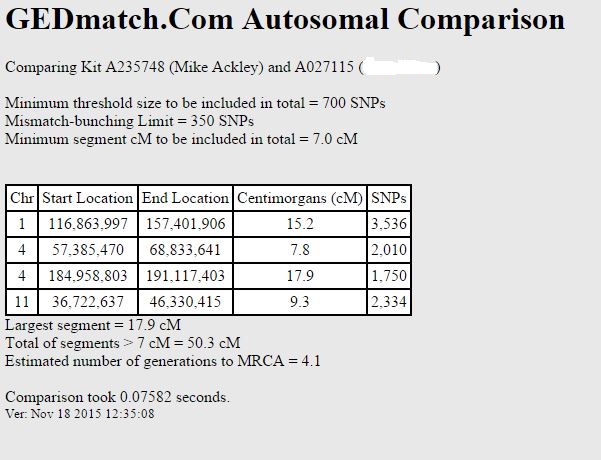
You can see that we have four pretty good-sized segments that match.
GEDmatch also has an ethnicity estimator. They also use a pre-defined set of reference tests to come up with their estimates (different than Ancestry and FTDNA). Here is what mine looks like:

There are also a couple of "fun" utilities, like this one that predicts eye color. They nailed it for me:


What the algorithm does is compares my DNA with all possible pairs of people that match me on each chromosome and checks to see if those pairs also match each other. So every line in the above snippet is a pair of kits that match me on chromosome 15 along with the start and end points of the matching segment and the length of the match. The first pair matches me between 24,150,013 and 27,388,629, so the three of us share a common ancestor -- now we need to do our genealogy homework and figure out who it is. Note that for the next three lines, kit 1 is the same kit, and kit 2 is three different kits, meaning the person from kit 1 and all three kit 2 people match me at that same location (sort of). Note that the starting location is the same for all of them, but the ending location of the first one is a little bit less than the other two. This is OK since the last two are a little bit longer; all five of us share at least a 17.3 cM segment on chromosome 15 so we have a triangulation group of five people and we share a common ancestor.
I know this is a lot of material, so you need to know what you can do next. My ultimate goal is to convince Ackleys to get together to share DNA results and help each other discover our ancestors, so hopefully I still have your interest at this point. Your next step depends on what you have already done.
If you have already tested with one of the "Big 3" and are interested in getting in on some type of Ackley project, you have a few choices:
This link is to the Wiki for the International Society of Genetic Genealogy (ISOGG). There are over 500 articles about all aspects of DNA testing and its use in genealogy. Some of them get a little deep technically, but I have found most of them to be quite understandable and they have really helped me learn about genetic genealogy. I highly recommend it. By the way, membership in ISOGG is free (I just joined).
http://www.isogg.org/wiki/Wiki_Welcome_Page
"It's the action, not the fruit of the action, that's important. You have to do the right thing. It may not be in your power, may not be in your time, that there'll be any fruit. But that doesn't mean you stop doing the right thing. You may never know what results come from your action. But if you do nothing, there will be no result."
--Mahatma Gandhi
I am relatively new to DNA testing, so I've tried to get up to speed on it by reading about it and subscribing to several blogs that discuss various aspects of using DNA in genealogy. I still have a lot to learn, but I think I have enough of a handle on it to have some ideas on how we could come together as a group and use it to our advantage.
If you are considering DNA testing, there are a couple of decisions to be made: which company to test with, and which type(s) of tests to do, which we'll discuss next. If you've already tested, hang in there, we'll talk about what we can all do a little later in this post.
Testing Companies
Although there are many companies that do DNA testing, there are really only three that you should consider for genealogical purposes. I regularly read a blog called "DNAeXplained" written by Roberta Estes that I think is worth reading if you are interested in using DNA for genealogy, and in this post she gives some good reasons why you shouldn't look anywhere but the "Big 3". As she writes, the "Big 3" are Family Tree DNA (sometimes abbreviated as FTDNA), Ancestry, and 23andMe. Roberta points out in her post that 23andMe is going through some upheaval right now as it relates to their genetic genealogy products, so for the time being she is recommending against 23andMe. So, that leaves FTDNA and Ancestry. I have experience with both companies; I have tested myself as well as seven other family members with Ancestry, and I have also transferred my results to FTDNA (for a fee) for reasons I will discuss below.
Types of Tests
There are four types of tests, each of which can be helpful for genealogy purposes in different ways. Roberta has a much more detailed post about the types (Y-DNA, mitochondrial, autosomal, and X) here, but for most of us autosomal and Y are the tests we are most likely to do, so I'll stick to these two here:
Autosomal DNA
Autosomal DNA is the DNA inherited through the autosomal chromosomes. Humans have 23 pairs of chromosomes; the 22 numbered pairs (1-22) are the autosomal chromosomes, and the 23rd pair are the sex (X and Y) chromosomes. Both parents contribute autosomal chromosomes, and the results of autosomal testing, along with genealogical information, can be used to discover familial relationships. Stated simply, you can identify your parents, siblings, aunts, uncles, cousins (recent and distant), and so forth using autosomal DNA test results. Both males and females can do autosomal testing. Both Ancestry and FTDNA offer autosomal testing; each has strengths and weaknesses when it comes to the tools provided to analyze your results. I'll talk more about that in the "What Do You Get When You Test?" section below.
Y-DNA
The Y chromosome is male-specific; the pair of sex chromosomes of males is made up of an X contributed by the mother and a Y contributed by the father, while females have two X chromosomes, one each from the mother and father. As a result, only men can do a Y test (sorry ladies!). However, all is not lost, women can get Y information for their family line by having their father, brother, uncle, or cousin in the direct family line test. The Y chromosome is passed from father to son virtually unchanged with a predictable rate of mutation, so the Y-DNA test is typically used to determine if there is a shared ancestor within a genealogical time frame. This is typically the test used in surname projects. Currently only FTDNA performs Y-DNA tests, so if you are interested in doing a Y test that is your only choice. Ancestry used to do Y tests (I did one several years ago before they stopped); if you have Y results from Ancestry you can transfer them to FTDNA for a fee and take advantage of the tools they have (which I have just done - waiting for the final results).What Do You Get When You Test?
Both Ancestry and FTDNA have mostly similar tools for autosomal tests, but each has what I see as a major weakness that the other one just does better. We'll get into that shortly, but here are the things they probably do equally well.
At the highest level, they both offer an estimate of your ethnicity. In fact, that is what Ancestry calls it, your ethnicity estimate. Here is what mine looks like:
 |
| Ancestry Ethnicity Estimate |
 |
| FTDNA myOrigins |
 |
| Ancestry Matches |
FTDNA has a similar approach to presenting detailed results. My list of FTDNA matches looks like this (once again I have blanked out the names):
 |
| FTDNA Matches |
If you click on one of your Ancestry matches, you will go to a page that looks like this:


This is similar to the "Shared cM" information that FTDNA gives. The other new feature is the "Shared Matches" button just above the tree; clicking on that will give you a list of people that match both you and the match you are currently viewing. This is similar to one of the tools available on FTDNA called "In Common With"; this can be helpful in trying to pinpoint just how you are all connected. These two features are the extent of the tools that Ancestry has that deal with the actual DNA piece of the puzzle; the rest of their tools relate more to the genealogy piece. For example, if you click on one of the shared surnames, you will get a list from your match's tree and your tree of everyone that has that surname. By clicking on "Boettcher", this box pops up:

This is useful in trying to figure out where the connection is; you can see that we both have a Frederick Boettcher (although I spelled it Friedrich). We have actually communicated with each other and determined that Frederick/Friedrich is indeed our shared ancestor. John Carl August Boettcher (his 2nd great grandfather) and Augusta Boettcher (my 2nd great grandmother) appear to be siblings. Unfortunately neither one of us knows much beyond that, but in the future we can help each other out if we find out more.
Ancestry also has a feature they call "Shared Ancestor Hints". They find these by comparing your tree with your match's tree to see if you have common ancestors somewhere along the way. I have a few of these; here is an example of one:

The couple at the top represents the shared ancestors; the two columns of people below them are the line of descent to me and my match to show how we are related. This match is my 8th cousin. This feature only works well if you and your match have well-developed trees and you happen to have spelled the names all the same (a different spelling of Frederick in the last example is why that match and I didn't have a "Shared Ancestor Hint"). There are a few other tools on Ancestry, but these are the main ones and it gives you an idea of what you can expect. On to FTDNA.
The genealogy tools on FTDNA are a little more crude, and as a result not as useful. For example, if you click on the little green tree icon that was pointed out above, it will show you your match's tree. It looks like this:

For me, this tool just feels really clunky. To move around in the tree you hold your left mouse button down and slide the tree around to look at different portions of it, making it very hard to really find anything. You can click on an individual and get their information, which looks like this:

That's about the extent of the genealogy related tools on FTDNA; they don't have anything like the Ancestry features discussed above. However, FTDNA does outshine Ancestry when it comes to tools designed to do analysis on the DNA matching side of things. For example, the chromosome browser allows you to compare up to five of your matches to see how you line up. Below is an example where I have compared three of my matches (whose names I have erased) that I identified with the "In Common With" tool; i.e., these three have matches to each other as well as to me.

You can drill down a little deeper by clicking on the "View this data in a table" link just about the graph. This will give you a table showing exactly which segments you match. For the orange individual above, it looks like this:

Note that all of the tools presented above are for working with autosomal DNA tests. The tools for Y tests are different. My results for the Y test look like this:

The other two matches both had the Ackley surname as expected (first names have been masked). Neither one of them listed their "Most Distant Ancestor", which is not very helpful. The "Most Distant Ancestor" is the type of information that could help in connecting otherwise unconnected lines of a particular surname. For example, if I had a match with someone who listed someone other than Nicholas Ackley as "Most Distant Ancestor", it would behoove us to look at each other's genealogies to see if we could determine a common ancestor. This could result in either an extension beyond Nicholas for me or a connection for my match to the Nicholas Ackley line that was previously unknown.
There are a couple of other things to take note of in this report. The "Genetic Distance" column is a measure of how close we match. A genetic distance of 0 means that we match each other exactly on all 12 markers tested. A genetic distance of 1 means that there is one marker where our values differ by 1. A note about the number of markers -- my original Y test with Ancestry was a 33-marker test, but not all of the markers were the same as the markers that FTDNA uses. So when I transferred my results to FTDNA, I received a test kit so I could give them a sample so additional markers could be tested. Until that kit is processed, I only have 12 markers that can be used for comparisons.
Note that next to each match there are a series of buttons that can be clicked to get additional information or send e-mail. Clicking the orange "TiP" button gives an additional report that looks like this:

A Couple of DNA Success Stories
OK, so how do you use this stuff in practice? I have had a couple of experiences that I think can illustrate how this could work. The first is from my mother's side of the family. My maternal grandmother's maiden name is Jones -- about as common as it gets (#5 on that list of surnames from the 2000 census that was discussed a few posts ago), which creates some problems -- there are just so many of them! Her father was born in Chicago, and after a little digging, I was able to figure out that her grandfather's name was William Jones. Well, there were over 50 men named William Jones in the Chicago directories, so that wasn't much help. I had kind of resigned myself to the fact that this might be a brick wall that I wasn't going to break down easily.
But then DNA testing came along, and I decided to have several family members tested, including my mother's cousin from the Jones side of the family (my mother was an only child and passed away before I could get her tested, so the closest living person I could get was her cousin). Shortly after my cousin's results were in, a match showed up whose last name was Jones, and boy did he look like my great uncle! I contacted him, and we began to compare notes, and soon discovered that we had to come from the same Jones family. We both had to do some more research to make the final connection, but in the end we were able to conclude that our Jones families came from England to Chicago in the 1860s and started a brick manufacturing business together. The DNA match led us to each other, but ultimately it was the diligent genealogy research we had both done that allowed us to connect all of the dots.
I have another DNA story that is still being written, but it will illustrate the point. Another brick wall on my Ackley side of the family is my 2nd great grandmother Marie (Jeannerette) Ackley. The story on how I even figured out her maiden name was Jeannerette is a topic all on its own; the problem here is that I just couldn't find anything on her father. The only clue I had came from her death certificate and the death certificate of a man who I'm reasonably certain is her brother. They both listed their mother as Mary Cecil, but one said the father's name was George and the other said James. Both Marie and her brother were born in Brooklyln, but I could not find any other Jeannerettes in New York. Census records for Marie and her brother were not consistent; some said their father was born in France (as did their death certificates), but others said he was born in South Carolina. In searching online for Jeannerettes I was getting a lot of hits in South and North Carolina but nothing in New York. It turns out that there were several French Huegenot Jeannerette/Jenerette families (there are other spellings too) that came to America in the 1700s, but I could not find any connection to any of them. Once again DNA is coming to the rescue. I have discovered at least three matches that all have common Jenerette ancestors from the Carolinas in their family trees. I have yet to make the final connection to them, but at least now I know where to look and I can focus my research much better.
My point in relating these experiences is that I am hoping if more Ackleys do DNA tests we might be able to start connecting with each other and solve some of the open questions we still have. There are Ackley lines in the United States that may or may not be related, and as discussed in the previous post I am not convinced that we know for sure who Nicholas Ackley's ancestors were. DNA may help us answer those questions.
Ackley Surname Project
FTDNA offers the ability to conduct projects, which are usually arranged along surname lines, but can also be geographic or ethnic in nature. There is an Ackley surname project on FTDNA (there are only 12 participants right now). Up until about 2 weeks ago the project appeared to be inactive; the link to the project website was broken and the project administrator was unreachable. I was able to get FTDNA to assign me as the project administrator, and I have managed to get the project website up and running. Here is the goal of the project as written by the previous project administrator:

GEDmatch
GEDmatch is a free website that allows users to upload autosomal DNA test results and offers a myriad of tools for analyzing matches. They will accept results from any of the "Big 3" companies mentioned above, and uploading is very easy. I have uploaded my test and all of the tests of my relatives. Besides the tools they offer, another big selling point for GEDmatch is that you can expand the number of matches you have because your test will be compared against people who have tested at all of the "Big 3" who have chosen to upload to GEDmatch. Here are some examples of the tools they offer:

This is a snippet of my list of matches from GEDmatch. As usual I have blanked out any real names and cut off the list of e-mail addresses in the last column on the right. Note that this is not a real slick interface, but it does what it needs to do (did I mention that it is free?). This output was produced by a utility that is called "'One-to-many' matches". You enter your kit number (this is how your test is identified) and it compares your kit to all of the other kits in the database and gives you a list of the top 1500 matches that meet the thresholds for segment length (which you can change if you want to). The top six matches in my list are my relatives who have tested; thus, the really high total cM values (EA is my dad, KA and JA are my siblings, JD is my dad's cousin on his dad's side of the family, SC is my mom's cousin on her mom's side of the family, and JL is my dad's cousin on his mom's side of the family). The last one you can see on this list is the same user who I showed in some of the Ancestry examples above -- the one with the Boettcher connection.
You may ask why I tested so many people, and there are several reasons. I tested my dad because he has DNA that I don't have -- I only got half of my DNA from him and half from my mom, so he will match people that I don't match. I tested my siblings because they got some of my mom's DNA that I didn't get, and since I wasn't able to test my mom before she died that is important. My dad's and mom's cousins for the same reason -- they got DNA from my great grandparents that my dad, mom, siblings, and I didn't get. With the cousins you get the added benefit that for anyone that matches me and them, I automatically know which of my sets of great grandparents they are related to, and that narrows down the search. For example, the Boettcher cousin I mentioned above also matches SC (my mom's cousin from her mom's side of the family) so I knew to look only on that side for surnames that are common between us.
Another tool available is a "One-to-one' compare". You can do a one-to-one compare with anyone in your list of matches by clicking on the A link under the "Autosomal" column, or from the main page you can select the one-to-one option and enter any two kit numbers you want to compare. Here is the one-to-one comparison for me and my Boettcher relative:
You can see that we have four pretty good-sized segments that match.
GEDmatch also has an ethnicity estimator. They also use a pre-defined set of reference tests to come up with their estimates (different than Ancestry and FTDNA). Here is what mine looks like:

There are also a couple of "fun" utilities, like this one that predicts eye color. They nailed it for me:

That is not a picture of my eye; it is the picture the utility picked to best represent what it predicted for me, along with a list of rules used to make the prediction. This is really close to my real eye color, and they got it right for my dad, siblings, and wife. Useless for genealogy, but fun nonetheless.
There is one final GEDmatch tool I'd like to discuss - the triangulation tool. While most of the GEDmatch tools are free, there is a small group that you have to pay for. There is no set fee -- if you donate at least $10 you get the additional tools for a period of time. The triangulation tool is worth the donation -- it does what I discussed above systematically ("Shared Matches" at Ancestry and "In Common With" at FTDNA) and gives you a list of everyone you triangulate with. Here is a snippet of some of my triangulated matches:

What to Do Next
I know this is a lot of material, so you need to know what you can do next. My ultimate goal is to convince Ackleys to get together to share DNA results and help each other discover our ancestors, so hopefully I still have your interest at this point. Your next step depends on what you have already done.
If you have already tested with one of the "Big 3" and are interested in getting in on some type of Ackley project, you have a few choices:
- The quickest, simplest, and cheapest thing to do (free) would be to upload your results to GEDmatch so you can start comparing your kit to other Ackleys who join, as well as the rest of the people in the database who might share non-Ackley ancestors with you.
- If you tested with FTDNA and haven't already done so, you can join the Ackley project there (also free).
- If you tested with Ancestry or 23andMe, you can pay a fee to transfer your results to FTDNA and get in on the Ackley project. The transfer fee for autosomal tests is $39, and the fee for the Y test depends; to transfer the results without any additional testing it is $19, but if you want to test some additional markers to mesh with FTDNA's standard number of markers it is $58. Once you have transferred, you can join the Ackley project for free.
If you have not already tested, here are some options:
- Decide which type of test you want to do. Males can choose either the Y test or the autosomal test; females can only do the autosomal test. The autosomal test is more robust in that it gives you information about all of your ancestors; the Y test is restricted to your patriline (line of descent through your male ancestors). The Y test could be more useful in figuring out Nicholas' ancestors or determining if your line is connected to Nicholas Ackley; the autosomal test would be more useful for general genealogy questions.
- Decide which company to test with. The autosomal tests at both Ancestry and FTDNA cost $99 normally, so cost won't be the deciding factor. Both companies run specials from time to time; I've seen them both as low as $79. So the decision comes down to whether you want Ancestry's better genealogy tools or FTDNA's better genetic tools. If you've spent a lot of time and effort building your tree on Ancestry and want to take advantage of that, you'll probably want to go with them. If you'd rather have better tools to do analysis, you'll probably want FTDNA. If you want it all, you can test at Ancestry and either upload your results to GEDmatch for free and use their tools or FTDNA for a fee and use their tools.
- For the Y test, your only choice is FTDNA. If you decide to do a Y test, you'll have the additional decision on how many markers to test; the more markers, the more expensive. The 37-marker test is $169, the 67-marker test is $268, and the 111-marker test is $359.
A few final words on next steps. First, you should know that I have no connection with either one of these companies, so I won't benefit whatsoever if you decide to test with either one of them. They both have a lot of my money!
Second, I know this can be a lot of money, so don't let me talk you into something you can't afford! I'm hoping that if you were already considering testing that this post will help you decide if you want to go through with it, and that if you do that you'll consider participating in some way with whatever project we can get going.
Finally, if you're already on FTDNA, join the Ackley project for free. It is easy to join and you might learn something. For those who want to participate in some way without dealing with FTDNA, I'd like to start an "informal" project on GEDmatch since they don't really have anything formal to conduct projects. That would entail just uploading your data to GEDmatch and then sharing your kit number with the rest of us so we can use their tools to do analysis. To get that rolling, I'll share my Ackley kit numbers here:
A235748 (me)
A590546 (my dad)
A833645 (my sister)
A913303 (my brother)
A588455 (my dad's Ackley cousin)
A couple of blog readers have already uploaded their results to GEDmatch and agreed to share. Their kit numbers are:
A527562 (John P. Ackley)
F364363 (Carol Harrison)
A couple of blog readers have already uploaded their results to GEDmatch and agreed to share. Their kit numbers are:
A527562 (John P. Ackley)
F364363 (Carol Harrison)
If anyone decides to upload to GEDmatch and wouldn't mind sharing your kit number, please post it in a comment on this post so we all can see it and use it for comparisons/analysis. I have created a separate "Ackley DNA Projects" page for the blog, and will keep an up-to-date list of all of the kit numbers there for easy reference. There is also a new page with instructions on how to download your data from Ancestry and upload to GEDmatch.
Additionally, I'm really hoping someone with the Hackley surname will test and share with us. That would really go a long way toward verifying or refuting the information in the post on Nicholas Ackley's ancestors.
Another thing to dream about is for people with Ackley ancestors in other parts of the world to test and add their results to the mix. If someone in England tested, that could give us a connection to the presumed origin of our family.
One final thought: I can't emphasize this enough -- using DNA testing successfully depends on having a well-developed family tree on both sides; i.e., both people in a match need to have done their genealogical homework. If two people match each other and one or both of them doesn't have a tree, they will learn next to nothing from the fact that they match. DNA doesn't tell you anything about who your ancestors were; it can only tell you if you share a common ancestor with someone you match. It is up to the two people who match to do the research to figure out who the common ancestor was.
Additionally, I'm really hoping someone with the Hackley surname will test and share with us. That would really go a long way toward verifying or refuting the information in the post on Nicholas Ackley's ancestors.
Another thing to dream about is for people with Ackley ancestors in other parts of the world to test and add their results to the mix. If someone in England tested, that could give us a connection to the presumed origin of our family.
One final thought: I can't emphasize this enough -- using DNA testing successfully depends on having a well-developed family tree on both sides; i.e., both people in a match need to have done their genealogical homework. If two people match each other and one or both of them doesn't have a tree, they will learn next to nothing from the fact that they match. DNA doesn't tell you anything about who your ancestors were; it can only tell you if you share a common ancestor with someone you match. It is up to the two people who match to do the research to figure out who the common ancestor was.
Discussion Questions
- Have you done a DNA test? If so, which company did you use? Which type of test did you do?
- Do you have any DNA success stories you can share?
- Would you be interested in participating in an Ackley DNA project?
Link of the Day
This link is to the Wiki for the International Society of Genetic Genealogy (ISOGG). There are over 500 articles about all aspects of DNA testing and its use in genealogy. Some of them get a little deep technically, but I have found most of them to be quite understandable and they have really helped me learn about genetic genealogy. I highly recommend it. By the way, membership in ISOGG is free (I just joined).
http://www.isogg.org/wiki/Wiki_Welcome_Page
Quote of the Day
"It's the action, not the fruit of the action, that's important. You have to do the right thing. It may not be in your power, may not be in your time, that there'll be any fruit. But that doesn't mean you stop doing the right thing. You may never know what results come from your action. But if you do nothing, there will be no result."